Showing posts with label 0000-1400 Middeleeuwen. Show all posts

4 Jan 2026

Perotinus

 Perotinus

https://open.qobuz.com/playlist/903810


Perotinus (often written Pérotin or Perotinus Magnus) was a Parisian composer active around 1200, associated with the Notre Dame school and the broader ars antiqua tradition of medieval sacred music. Very little personal biography survives; most of what we know comes from medieval sources such as the English student called Anonymous IV, who names him Magister Perotinus and credits him with several influential polyphonic works.


Importance

Perotinus is important because he advanced Western polyphony from two voices into stable three- and four-voice textures and helped codify rhythmic organization in notated music. His work marks a clear step toward greater complexity and formal control in liturgical composition, and he is one of the first composers whose name can be reliably attached to specific multi-voiced pieces from the period.


Most remarkable compositions and why they matter

Viderunt omnes (four-voice organum) — notable for its extended, sustained tenor against florid upper voices and for demonstrating how four independent vocal lines could be coordinated rhythmically and harmonically; it became a benchmark of Notre Dame polyphony.

Sederunt principes (four-voice organum) — another large-scale four-voice work that displays Perotinus’s command of contrapuntal layering and rhythmic stratification, used as a model for subsequent composers in handling long-range structure in liturgical settings.

Alleluia Nativitas and other Alleluia settings (three-voice and two-voice organum) — these show his range from more compact three-voice textures to monumental four-voice pieces, illustrating how modal rhythm and measured clausulae were applied in practice.

Each of these pieces is significant because it makes audible the shift from freer, improvised-sounding organum toward deliberately composed, rhythmically organized polyphony that could be taught, copied, and transmitted.


How he influenced later musical developments

Rhythmic notation and mensural thinking: Perotinus worked within and helped extend the rhythmic schemes preserved in the Magnus liber organi, contributing to the move from ad hoc rhythmic alignment to notated rhythmic modes that later evolved into mensural notation; this made more precise composition and teaching possible.

Expansion of polyphonic textures: By composing reliable three- and four-voice works, he set technical and aesthetic precedents for the motet and for later medieval and Renaissance polyphony, where multiple independent lines became central to musical structure.

Pedagogical and repertory effects: Because authorship was recorded and his pieces circulated in manuscripts, Perotinus’s works served as exemplars in cathedral schools and among later composers, embedding his techniques into the Western compositional tradition.


Legacy and listening

Perotinus’s music survived in manuscript compilations associated with Notre Dame and was discussed by medieval theorists; modern ensembles and scholars have reconstructed and recorded his works, which continue to be studied as turning points in the history of polyphony. For direct experience, recordings of the Magnus liber organi (which include Perotinus’s Viderunt and Sederunt) give the clearest sense of his sound-world and technical innovations

26 Apr 2015

El Canto de la Sibila


El Canto de la Sibila


Music and religion, it seems that they are very connected. In an earlier blog, we saw religion being the source of inspiration for great composers like Anton Bruckner. Also the first music captured on paper and so surviving times was the Gregorian Chant, bringing the audience into a state of devoutness.

In 2010 Unesco recognized `El Canto de la Sibila` as intangible cultural heritage. The Song of the Sibyl is a liturgical drama and a Gregorian chant which is performed in allmost all churches of Mallorca and in the Italian city of Alghero at the evening church services on December 24th. Recently, it has been recovered in other locations such as Barcelona and in the Valencian cities of Onteniente, Jaraco and Gandia. 

The chant was introduced all around Europe in the Middle Ages and it reached Majorca with the Christian conquest in 1229. The lyrics compose a prophecy describing the Apocalypse.
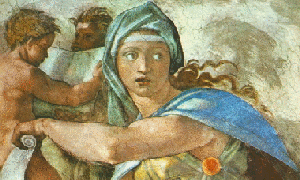
The figure of Sibil comes from the time of ancient Greece. There are many persons who are referred to as Sibil and these women were oracles in, for example Delphi. They were incorporated into the Christian Church as their apocalyptic visions included the promise of the second coming of Jesus Christ to judge the world. Michelangelo included Sibil in his beautiful paintings in the Sistine Chapel, so confirming the importance she and her messages had for the church as it leaves nothing to the imagination of what will happen to unbelievers:

The Day of Judgement
will appear For those who have made ​​service.
Jesus Christ, Universal King,
eternal God and true man
Heaven will come to pass judgment
and give to each their just reward.

Great fire will come down from Heaven;
springs and rivers will all burn.
Fish will scream loudly
losing the natural charms

The sun will lose its brightness
becoming dark and veiled.
The moon will give no light
and the whole world will be full of sadness.
To evil people I will say bitterly:
- Go, you damned, into the torment!
Go, go to the eternal fire
With your Prince of Hell

In the present-day performance, a boy or girl sings, accompanied by two or more Altar boys carrying candles. The singer holds a sword upright in front of his or her face during the entire song. The verses are sung in a single voice and without instrumental accompaniment, apart from when the organ plays between the verses. 

It is fascinating to listen and look to the performance of this work, it is as looking back 800 years and easy to imagine the impact it had and still has on the audience in a dark and cold church in the middle of the winter: Believe or Die


22 Apr 2015

Machault - Messe de Notre Dame

Machaut


https://open.qobuz.com/playlist/51041149

Messe de Nostre Dame
 is a beautiful polyphonic mass composed before 1365 by French poet and composer Guillaume de Machaut (c. 1300–1377). It is one of the great masterpieces of medieval music and of all religious music. Unlike the Tournai Mass, it is not a compilation from several composers but was created by Guillaume as a single work. 


Machaut was familiar with the Tournai MassThe Gloria and Credo of the Messe de Nostre Dame show similarities to the Tournai mass, such as textless musical interludes, simultaneous style, and long melismatic Amens. The other four movements of Machaut's mass are composed in motet style with mass text.

For me, the Pater Nostre is one of the most lovely pieces, as it reminds me of being as a young kid in the cloister of my uncle, who was a Benedictine monk. Their chant was filling the church the same time as the incense was filling it and the sun entering through the Rose window. Felt like a heavenly experience.

Please also listen to the Introitus with the beautiful bells joining the voices!

https://open.qobuz.com/playlist/51041149