2 Dec 2018

Piano concert in A - Grieg


Grieg – Pianoconcert in a‑mineur, Op. 16

https://open.qobuz.com/playlist/50883261

Het Pianoconcert in a‑mineur van Edvard Grieg is een van de meest geliefde pianoconcerten uit de romantiek. Het combineert Noorse volksmuziek, lyrische melodieën en briljant pianospel met een verrassend verfijnde structuur. Hoewel het werk toegankelijk klinkt, zit het vol subtiele muzikale keuzes die het tot een meesterwerk maken.

In deze luistergids neem ik je mee door de drie delen, met aandacht voor vorm, harmonische wendingen, thematische ontwikkeling en pianotechniek.


I. Allegro molto moderato

Vorm: sonatevorm
Toonsoort: a‑mineur
Karakter: dramatisch, virtuoos, volksmuzikaal

De beroemde opening

Het concert begint met een trommelende paukenroffel gevolgd door een dalende pianocadens: een gebaar dat meteen de toon zet. De cadens is technisch indrukwekkend, maar ook thematisch belangrijk: het dalende motief keert later terug in verschillende gedaanten.

Muziektechnisch interessant:

  • De opening is een omkering van het stijgende motief dat later het hoofdthema vormt.
  • De cadens staat niet los, maar introduceert het materiaal van het hele deel.

Hoofdthema (a‑mineur)

Het orkest presenteert een breed, volks geïnspireerd thema. De melodie heeft de typische Noorse springdans‑ritmiek: een combinatie van 2‑delige en 3‑delige accenten die een licht hobbelend gevoel geven.

Let op:

  • De syncopen in de strijkers
  • De mixolydische kleur (verlaagde 7e toon) die het thema een volks karakter geeft

Tweede thema (C‑majeur)

Het tweede thema is een lyrische, bijna vocale melodie in de piano. Het staat in de verwante toonsoort C‑majeur, zoals gebruikelijk in sonatevorm, maar Grieg geeft het een pastorale, open klank door veel gebruik van sext‑ en none‑akkoorden.

Muziektechnisch:

  • De begeleiding gebruikt gebroken akkoorden die doen denken aan Noorse hardangerfiddle‑patronen.
  • De melodie beweegt vaak in tertsen, een typisch romantisch gebaar.

Doorwerking

Hier wordt het materiaal uit beide thema’s fragmentarisch verwerkt:

  • het dalende openingsmotief
  • ritmische cellen uit het hoofdthema
  • harmonische modulaties naar verre toonsoorten (o.a. F‑majeur, e‑mineur)

Grieg gebruikt veel sequensen (herhalingen op andere toonhoogten), waardoor de spanning geleidelijk wordt opgebouwd.

Reprise en slot

De reprise volgt de klassieke vorm, maar Grieg laat de piano extra schitteren met virtuoze loopjes en octaafpassages. Het deel eindigt in een krachtige a‑mineur, maar met een glimp van lyriek.


II. Adagio

Toonsoort: D‑majeur
Karakter: warm, zangerig, intiem
Vorm: liedvorm (A–B–A)

Dit deel is een oase van rust. De keuze voor D‑majeur (de grote terts boven de hoofdtoonsoort) geeft een gevoel van openheid en verlichting.

A‑gedeelte

Het orkest introduceert een brede, zangerige melodie. De harmonie is rijk maar niet zwaar: veel gebruik van subdominantkleur (G‑majeur) en nevenakkoorden die de melodie laten ademen.

De piano speelt hier vooral begeleidende figuren:

  • arpeggio’s
  • zachte akkoordbrekingen
  • ornamenten die doen denken aan nocturnes van Chopin

B‑gedeelte

Hier wordt de sfeer donkerder:

  • modulaties naar b‑mineur en fis‑mineur
  • chromatische dalende baslijnen
  • meer dramatische pianopassages

Dit is het emotionele hart van het deel.

 Terugkeer van A

De opening keert terug, maar rijker georkestreerd. De piano krijgt meer ruimte om te zingen, met subtiele versieringen.


III. Allegro moderato molto e marcato

Vorm: rondo‑sonate
Karakter: ritmisch, volks, feestelijk
Toonsoort: a‑mineur → A‑majeur

Het finale‑deel is sterk beïnvloed door Noorse halling‑ en springdansritmes. De accenten liggen vaak op onverwachte plaatsen, waardoor het deel een dansende, bijna stuiterende energie krijgt.

Rondo‑thema

Het hoofdthema is ritmisch scherp, met veel accentverschuivingen en staccato‑figuren. De piano speelt hier virtuoze patronen in parallelle tertsen en sexten.

Lyrisch tweede thema (F‑majeur)

Een prachtig contrast: een brede melodie die bijna als een volkslied klinkt. De piano begeleidt met warme akkoorden.

Doorwerking

Hier combineert Grieg:

  • ritmische cellen uit het rondo‑thema
  • fragmenten van het lyrische thema
  • modulaties naar onverwachte toonsoorten (o.a. H‑mineur, D‑majeur)

De piano krijgt hier veel ruimte voor virtuositeit: octaven, arpeggio’s, snelle wisselnoten.

Triomfantelijke coda

Het werk eindigt in A‑majeur, een stralende omkering van de donkere opening. De laatste pagina’s zijn pure vreugde: brede akkoorden, volle orkestklank en een finale die voelt als een zon doorbrekend na een storm.


Tot slot

Griegs pianoconcert is niet alleen een romantisch showstuk, maar ook een subtiel geconstrueerd werk vol Noorse invloeden, harmonische verfijning en thematische samenhang. Het is muziek die zowel het hart als het hoofd aanspreekt — en die bij elke luisterbeurt nieuwe details prijsgeeft.


23 May 2015

Shostakovich - 8th Quartet

A life in 20 minutes


Listen to Shostakovich 8th quartet and you have heard half his other work as well. This work written in 1960, seems to reflect the composer full emotional journey. Stories tell that Shostakovich was suicidal at this point in time, struggling with his health and with his decision to finally join the Communistic Party. His son recalled that his decision brought Shostakovich in tears[50] and he later told his wife Irina that he had been blackmailed.[51].
Shostakovich's musical response to these personal crises was the Eighth String Quartet, composed in only three days. He subtitled the piece, "To the victims of fascism and war",[54] ostensibly in memory of the Dresden fire-bombing that took place in 1945.

Like the Tenth Symphony, this quartet incorporates quotations from his musical monogram DSCH and work from the past: his symphonies 1 & 5, the Cello Concerto and the opera Lady Macbeth of Mtsenk). It shows the freedom of mind Shostakovich still had. The opera was the vehicle for the  general denunciation of Shostakovich's music by the Communist Party in early 1936. Shostakovich also brings in a Jewish melody in the second movement, which he had also used in the 2nd Piano Trio in 1944. He was intrigued by Jewish music’s "ability to build a jolly melody on sad intonations".[76], , but as you can picture, Jewish music was not so popular in the Stalin days.

Some modern composers have been critical on the work of Shostakovich. Pierre Boulez dismissed Shostakovich's music as "the second, or even third pressing of Mahler".[86] The Romanian composer and Webern disciple Philip Gershkovich called Shostakovich "a hack in a trance".[87] A related complaint is that Shostakovich's style is vulgar and strident: Stravinsky wrote of Lady Macbeth: "brutally hammering ... and monotonous".[88] English composer and musicologist Robin Holloway described his music as "battleship-grey in melody and harmony, factory-functional in structure; in content all rhetoric and coercion."[89]
Well listen for yourself in this 8th Quartet, especially the recreation by Shostakovich pupil Rudolf Barshai. Shostakovich declared that the arrangement was an improvement of the original. I guess a comment like that for a re-work of this so personal piece, can be considered a hugh compliment. 

The piece start with 5 minutes of such mournful music, clearly the componer carries the whole world on his shoulders. The second piece is almost like the opposite and typical Shostakovich: high energy, almost violent. The third piece seems inspired by the Danse Macabre and he finishes with the Russian song  “Exhausted by Harsh Imprisonment”.

I like these emotional expressions with deep dark music. You as well?


About me and this blog


About me

My name is Sjang Ramaekers, and I am drawn to music that leaves a mark — music that stirs something in me, that opens a door I didn’t know was there. When a piece moves me, I like to wander through its world, read about it, learn from it, and capture what I discover along the way. What I write is not a scholarly analysis; it is an attempt to understand the music and the emotions it awakens, to trace the lines between sound and feeling.

This blog is my external memory, a place where I gather what resonates. I borrow insights from others and will mention it when I do — at least, when I remember. And chat helps me shape these reflections quickly and lightly, so the ideas don’t slip away before I can catch them.


17 May 2015

Vivaldi - Nisi Dominus

Competing for the best


Chiesa di S. Maria della Pietà
https://open.qobuz.com/playlist/50917223

In the Netherlands, we had a time where youth choirs made it attractive for people to go to the church for a ceremony. The churches were interested in having good choirs to attract a new audience and the choirs were happy as they had a platform to perform.

In the time of Vivaldi, we had a similar situation in the sense that churches were competing against each other but also against concert halls to bring the best possible music.

And if you had to compete who better to have for writing the music than priest and musician Antonio Vivaldi (1678-1741). Vivaldi mind was certainly with music, perhaps more then with being a priest. During masses, he simply stopped if a musical thought had to be captured. Life is all about setting the right priorities.  

He may have gotten the assignment from the Ospedale della Pieta, where he was working as a violin teacher in 1703, to compose the Nisi Dominus (RV 608). In the Ospedale della Pieta, Vivaldi had excellent singers and very strong instrumentalists, which you can hear in the way the piece is set up.

The part for the viola d ‘amore for the Gloria was written down  treating three of the four upper strings as transposing ‘instruments’—the open strings of the viola d’amore are tuned to D, F and D instead of the E, D and G familiar to a violinist—a procedure that leads to bizarre visual effects.  Fingered as they would be on the violin, however, the notes make perfect harmonic and melodic sense. (Michael Talbot)

“ The Nisi Dominus (Psalm 126) is a long and very ambitious piece whose nine movements vary enormously in their style and scoring. It has two simple continuo arias (´'Vanum est vobis' and 'Beatus vir'), one with string accompaniment in unison with the voice ('Sicut sagittae'), two lively concerto church arias ('Nisi Dominus', and its reprise 'Sicut erat in principio') and one ('Cum dederit') that's written in the slow siciliana style with chromatically ascending lines that Vivaldi often used to convey the idea of rest and sleep. It's third movement ('Surgite') is an accompanied recitative in which Vivaldi juxtaposes rapid ascending figures with slow ones at 'panem doloris'. At the words "Sicut erat in principio" (As it was in the beginning), Vivaldi calls on the old Baroque trick of returning to music heard at the very beginning of the work. The 'Gloria', which instead of being the expected set of joyous exclamations is a marvelously dark and solitary passage that leads us, suitably chastened, to the Alleluia-like Amen.”  (from markfromireland’s site Saturday Chorale)

The part I like most is the fourth movement, an Andante, which begins by relating how the Lord gave his beloved people both sleep and children.

Cum dederit dilectis suis somnum: 
ecce haereditas Domini, filii: merces, fructus ventris.

For he brings rest to those he has chosen

behold an inheritance from the Lord – sons:
a reward, the fruit of the womb.


The ‘Cum dederit’ is music of the greatest poise and delicacy, similar in mood to some of the slow movements in The Four Seasons, except more chromatic and suspenseful.

Please listen and sit back.


2 May 2015

Monteverdi - Orfeo

Don´t Look Back


You will find lots of documents describing the importance of Monteverdi´s masterpiece Orfeo (1607). It is being regarded as the first real opera by many and seen as one of the very best, and still performed regularly today.

Monteverdi blends ancient Greek mythology with his highly innovative and expressive music style, going against the strict rules of the contemporary style. 

Monteverdi's work is regarded as revolutionary, marking the change from the Renaissance style of music to that of the Baroque period.[2] 

He developed two styles of composition: the prima practica – the heritage of Renaissance polyphony, and the new basso continuo technique of the Baroque, the seconda practica.[3] In Prima pratica the harmony controls the words.[10] InSeconda pratica the words should be in control of the harmonies.[10] 

Prima pratica was the ideal of the sixteenth century, with flowing strict counterpoint, prepared dissonance, and equality of voices. Seconda pratica uses much freer counterpoint with an increasing hierarchy of voices, emphasizing soprano and bass, adding recitatives and basso continuo. This represents a move towards the new style of monody, with a single solo line with musical accompaniment, in opposition to homophony and polyphony, in which groups of voices sang independently and with a greater balance between parts.

For this major musical development, Monteverdi selects the really powerful story of Orpheus & Eurydice. Just after their marriage, Orpheus loses his wife Eurydice because of a bite of a snake. Orpheus is a gifted singer and goes with his lyre to the world of the death and convinces Hades to give him back his so beloved wife. Hades agrees but under one condition. During the trip back to the world, Orpheus is not allowed to look back to see if his wife is still following him. Of course agreeing, he then walks with a joyful spirit back our earth. But slowly he starts to doubt if she is following him. A sudden terrible noise makes him so concerned and doubtful that he does look back. In a split second he sees the beautiful shining eyes of Eurydice again but then she leaves for ever. 

Monteverdi follows the story in a beautiful telling manner (act 4). The upbeat during the first part of the walk, then a slow down with the questioning and doubting Orpheus. The sudden noise, music stopping and then with Eurydice in sight, the harsh and cold harpsichord changes for just a few bars into the soft organ sound before Eurydice vanishes.

Lesson for all of us, you can’t win from death but still you should not look back and focus on the future!

The piece I like perhaps most from this opera, depending on my own mood,  is ‘Rosa del Ciel’, in which Orpheus sings about his happiness with his beloved wife. I like it maybe so much as Rosa is also the name of my daughter, who is soon returning for a couple a days from far away Canada, (although I would not compare that to the Underworld).

Look forward to hear this beautiful piece of music


26 Apr 2015

El Canto de la Sibila


El Canto de la Sibila


Music and religion, it seems that they are very connected. In an earlier blog, we saw religion being the source of inspiration for great composers like Anton Bruckner. Also the first music captured on paper and so surviving times was the Gregorian Chant, bringing the audience into a state of devoutness.

In 2010 Unesco recognized `El Canto de la Sibila` as intangible cultural heritage. The Song of the Sibyl is a liturgical drama and a Gregorian chant which is performed in allmost all churches of Mallorca and in the Italian city of Alghero at the evening church services on December 24th. Recently, it has been recovered in other locations such as Barcelona and in the Valencian cities of Onteniente, Jaraco and Gandia. 

The chant was introduced all around Europe in the Middle Ages and it reached Majorca with the Christian conquest in 1229. The lyrics compose a prophecy describing the Apocalypse.
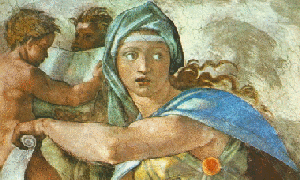
The figure of Sibil comes from the time of ancient Greece. There are many persons who are referred to as Sibil and these women were oracles in, for example Delphi. They were incorporated into the Christian Church as their apocalyptic visions included the promise of the second coming of Jesus Christ to judge the world. Michelangelo included Sibil in his beautiful paintings in the Sistine Chapel, so confirming the importance she and her messages had for the church as it leaves nothing to the imagination of what will happen to unbelievers:

The Day of Judgement
will appear For those who have made ​​service.
Jesus Christ, Universal King,
eternal God and true man
Heaven will come to pass judgment
and give to each their just reward.

Great fire will come down from Heaven;
springs and rivers will all burn.
Fish will scream loudly
losing the natural charms

The sun will lose its brightness
becoming dark and veiled.
The moon will give no light
and the whole world will be full of sadness.
To evil people I will say bitterly:
- Go, you damned, into the torment!
Go, go to the eternal fire
With your Prince of Hell

In the present-day performance, a boy or girl sings, accompanied by two or more Altar boys carrying candles. The singer holds a sword upright in front of his or her face during the entire song. The verses are sung in a single voice and without instrumental accompaniment, apart from when the organ plays between the verses. 

It is fascinating to listen and look to the performance of this work, it is as looking back 800 years and easy to imagine the impact it had and still has on the audience in a dark and cold church in the middle of the winter: Believe or Die


25 Apr 2015

Bruckner - Songs

Devote

What kind of a person was Anton Bruckner?. Mahler describes him as half an idiot, half a genius. Very devote, falling in love with teenage girls even at higher age, keeping a photo of his dead mother (as he had no photo from her still alive....). It indeed pictures a remarkable man. Also an insecure man it looks like when it concerns his work. For most of his symphonies we know of many re-writes as Bruckner wanted to please his critics of whom there were many. 

Max Kalbeck, a friend of Brahms wrote in the Wiener Allgemeine Zeitung, February 13, 1883:

The tonal ghosts are altogether too mad: it is as though a pack of wolves met on Walpurgis Night, such stamping and roaring, raging and screaming goes wildly on. If the future can relish such a chaotic piece of music, with sounds echoing from a hundred cliffs, we wish that future to be far away from us.

Where Bruckner had no struggle was with his devotion to God: he believed. Where we see in Mahler searching for God in Nature and in himself and going from assurance to doubt, Bruckner sang of his God and for his God. His 9th symphony was dedicated to God and he hoped He would grant him the time to finish it. Which didn't happen as he had to leave the work unfinished.

Bruckner studied intensively the music of Palestrina and Bach and after working as an organist at the court of Vienna and taken over from his teacher Sechter his professorship at the Vienna Conservatory, he spent his final decades creating his nine symphonies. These symphonies are sometimes refer to as "cathedrals of sound". Mahler expands the scope of the symphony even further - he famously argued with Sibelius that a symphony should contain the universe. - and he created an unmistakably modern musical language by including sounds from the ‘outside world’, using cowbells, military band music, uncommon wind instruments, mandolins and guitars, even vocal soloists and chorus

Ave Maria
My choice here is not for one of these complex symphonies but his motet Ave Maria. The work dates from 1861 and features three parts for female and four for male voices. Witzenmann links Bruckner's Ave Maria to four motets of Palestrina one being the Stabat Mater. 

Close your eyes when listening!

Anton Bruckner – Locus iste (1869): een heilige ruimte in klank

Sommige muziekstukken zijn klein van omvang maar groots van betekenis. Locus iste van Anton Bruckner is precies zo’n werk: slechts 48 maten lang, maar spiritueel en muzikaal verbluffend rijk. Het motet werd in 1869 geschreven voor de inwijding van de Votivkapelle van de nieuwe kathedraal in Linz, waar Bruckner zelf jarenlang organist was. De tekst komt uit het Latijnse gradual: “Locus iste a Deo factus est” — “Deze plaats is door God gemaakt”.

Het resultaat is een miniatuur die klinkt als een kathedraal: helder, plechtig, en vol subtiele spanningen die langzaam oplossen in rust.


Een motet als klankarchitectuur

Bruckner was diep religieus, en dat hoor je. Locus iste is gebouwd als een architectonisch gewelf: drie bogen die samen een serene, heilige ruimte vormen.

Vorm: A – B – A’

  • A (m. 1–12): helder, consonant, in C‑majeur
  • B (m. 13–29): spanningsvol, chromatisch, modulaties naar D‑ en E‑mineur
  • A’ (m. 30–48): terugkeer naar rust, maar rijker en voller dan het begin

De eenvoud van de buitenste delen contrasteert prachtig met de emotionele diepte van het middendeel.


Harmonie: eenvoud én verfijning

Hoewel het werk eenvoudig klinkt, zit het vol subtiele harmonische details die typisch zijn voor Bruckner.

Phrygische cadens (m. 15–16)

Een plechtige, bijna archaïsche cadens die perfect past bij de sacrale tekst.

Chromatische spanning in het B‑deel

De muziek dwaalt af naar D‑mineur en E‑mineur, alsof de zekerheid van de heilige ruimte even wordt losgelaten.

Onvoorbereide dissonant (m. 22)

Een rauw moment van expressie: de altstem introduceert een dissonant die niet wordt voorbereid, maar wél prachtig oplost.

Valse relatie (m. 12–13)

Een subtiele kleurverschuiving tussen partijen — een typisch Bruckneriaans detail dat diepte geeft zonder de helderheid te verstoren.

Uitgebreide slotcadens

De laatste maten vormen een langgerekte, chromatisch verrijkte cadens die eindigt in een stralend C‑majeur. Het voelt als een diepe ademhaling.


Melodie en stemvoering

De melodie is overwegend conjunct (stapjes), wat rust en eenvoud uitstraalt. Maar Bruckner plaatst er enkele expressieve intervallen tussen:

  • een opvallende grote septiem in de sopraan (m. 9–10)
  • imitatieve passages tussen de stemmen
  • polyfone verweving die doet denken aan renaissance‑technieken

Alles in dit werk komt voort uit kleine motieven die Bruckner op meesterlijke wijze varieert. Geen maat is willekeurig.


Klankwereld: een koor als orgel

Locus iste is geschreven voor vierstemmig a‑capellakoor (SATB).
De klank is:

  • warm
  • transparant
  • plechtig
  • gedragen

Bruckner denkt hier als organist: hij bouwt klanklagen op alsof hij registers opent en sluit. De A‑delen zijn als zachte fluitregisters; het B‑deel klinkt als een donkere prestant of gedekte pijp.


Waarom dit werk zo sterk is

Locus iste is een paradox: eenvoudig én complex, klein én monumentaal, stil én intens. In slechts 48 maten schept Bruckner een muzikale ruimte die voelt als een kapel van klank.

Het werk raakt omdat:

  • de vorm perfect in balans is
  • de harmonie subtiel maar expressief is
  • de melodie eenvoudig maar betekenisvol is
  • de tekst en muziek volledig samenvallen

Het is muziek die niet alleen klinkt, maar ademt.


Tot slot

Locus iste is een van de mooiste voorbeelden van Bruckners spirituele stijl: een gebed in muziek, een meditatie op heiligheid, een miniatuur die klinkt als een kathedraal. Het is een werk dat je niet alleen hoort, maar ervaart — precies zoals Bruckner het bedoeld moet hebben.

Anton Bruckner – Christus factus est (1884): nederigheid, overgave en mystieke intensiteit

Waar Locus iste klinkt als een serene klankkapel, is Christus factus est een spirituele klim: van nederigheid naar glorie, van duisternis naar licht. Dit motet uit 1884 behoort tot Bruckners meest aangrijpende religieuze werken. Het is geschreven voor vierstemmig koor met rijke harmonische uitwaaieringen en een dramatische spanningsboog die doet denken aan zijn symfonieën — maar dan in miniatuurvorm.

De tekst komt uit de Filippenzenbrief (Christus factus est pro nobis obediens usque ad mortem), een meditatie op Christus’ gehoorzaamheid tot de dood. Bruckner, zelf diep religieus, zet deze woorden om in muziek die klinkt als een innerlijke strijd én een overgave.


Een architectuur van nederigheid en glorie

Christus factus est is opgebouwd als een geleidelijke opwaartse beweging. Waar Locus iste een boogvorm heeft, werkt dit motet als een spanningsspiraal: elke frase tilt de muziek hoger, intenser, donkerder of stralender.

Globale vorm

  • Begin: zacht, nederig, bijna fluisterend
  • Midden: chromatische intensiteit, dissonanten, dramatische modulaties
  • Einde: een stralende climax op “exaltavit illum”

Het werk eindigt niet in triomf, maar in een plechtige, ingetogen rust — alsof de muziek neerknielt.


Harmonie: chromatische diepte en spirituele spanning

Bruckner gebruikt in dit motet een harmonische taal die veel gedurfder is dan in Locus iste. De chromatiek is niet decoratief, maar expressief: elke modulatie draagt betekenis.

Chromatische opstijgingen

De muziek klimt voortdurend omhoog via kleine secundes — een symbool van innerlijke worsteling en spirituele groei.

Dissonanten als expressie

Bruckner gebruikt:

  • onvoorbereide dissonanten
  • vertraagde resoluties
  • parallelle chromatische lijnen

Deze momenten voelen als pijn, spanning, of het gewicht van de tekst.

Modulaties naar verre toonsoorten

Het motet beweegt door:

  • e‑mineur
  • g‑mineur
  • b‑mineur
  • en uiteindelijk naar een stralend D‑majeur

Die laatste modulatie voelt als een deur die opengaat.


Melodie en stemvoering

De melodie is minder conjunct dan in Locus iste: Bruckner gebruikt grotere intervallen om de dramatiek te vergroten.

Kenmerken:

  • expressieve sprongen in de sopraan
  • imitatie tussen stemmen
  • polyfone verweving die doet denken aan renaissance‑technieken
  • maar met romantische harmonische rijkdom

De climax op “exaltavit illum” is een van de meest indrukwekkende momenten in Bruckners koormuziek: de stemmen stijgen als één lichaam omhoog.


Klankwereld: donker, plechtig, mystiek

Het motet is geschreven voor vierstemmig a‑capellakoor (SATB), maar Bruckner denkt hier als een symfonicus:

  • diepe bassen die fundamenten leggen
  • koperachtige akkoorden in de tenoren
  • stralende sopraanlijnen die door de textuur heen breken
  • een klank die soms aan orgelregisters doet denken

De sfeer is donkerder dan in Locus iste, maar ook intenser en emotioneler.


Waarom dit werk zo sterk is

Christus factus est raakt omdat het een innerlijke reis verbeeldt:

  • van nederigheid (factus est obediens)
  • naar lijden (usque ad mortem)
  • naar verheffing (exaltavit illum)

Bruckner vertaalt deze theologische beweging in een muzikale spanningsboog die bijna symfonisch aanvoelt. Het werk is kort, maar klinkt als een spirituele klimtocht.


Tot slot

Christus factus est is een van Bruckners meest indrukwekkende motetten: een werk dat niet alleen de tekst verklankt, maar de luisteraar meeneemt in een innerlijke beweging van duisternis naar licht. Het is muziek die plechtig, mystiek en diep menselijk is — een gebed in klank, een meditatie op overgave.